HMO Cleaning Obligations for Manchester Landlords, What the Licence Expects
The condition report that decides whether your licence gets renewed
Manchester City Council does not licence a House in Multiple Occupation once and forget about it. Every licensed HMO is subject to inspection, and the condition of the shared spaces is one of the first things an inspector looks at, because a dirty hallway or a neglected shared kitchen is treated as an early sign of wider management neglect. Landlords who run a genuinely tight cleaning schedule rarely have a difficult inspection. Landlords who treat cleaning as something the tenants sort out among themselves usually do.
This guide sets out what an HMO licence actually expects on cleanliness in the shared parts of the building, where responsibility sits between landlord and tenant, and how to build a schedule that holds up when the council calls. If you would rather have a fixed schedule running in the background, our communal area cleaning service in Manchester covers shared kitchens, bathrooms, hallways and stairwells across licensed HMOs city wide.
Who needs a licence, and why it matters for cleaning
Manchester operates additional and selective licensing across large parts of the city, which means many smaller shared houses need a licence that would not require one under the national minimum rules alone. Before you even reach the cleaning question, it is worth checking directly with the council whether your property falls inside a designated licensing area, since the answer changes what you are legally required to demonstrate.
Once a property is licensed, the licence itself carries conditions, and those conditions are not vague aspirations. They are specific, they are checked, and a failure to meet them can lead to enforcement action, a licence being revoked, or a penalty. Housing charity Shelter’s guidance on HMO licence types and conditions sets out what those standard conditions actually cover, and cleanliness of the shared parts of the building sits inside that framework alongside gas safety, electrical safety, fire precautions and adequate amenity provision, not as an afterthought to it.
The conditions Shelter describes are not unique to any one council. Kitchen facilities have to be suitable in number and condition for the people using them, common parts and shared installations have to be kept clean and in good decorative order, and fire precautions including self closing doors and clear escape routes are treated as licence conditions in their own right rather than optional extras. Manchester’s own additional and selective licensing schemes sit on top of that baseline, which is why a shared house that would not need a licence under the national minimum rules can still need one here.
What the licence actually expects in shared spaces
Shared kitchens
A shared kitchen used by unrelated tenants needs to be kept clean and in good decorative order, with surfaces, floors and appliances capable of being properly cleaned in the first place. That means intact worktops without rot or damage, flooring that can be mopped rather than absorbent carpet, and appliances that are functioning and free of accumulated grease. The landlord’s obligation is to provide a kitchen that is capable of being kept clean and to make sure it is presented that way at the point tenants move in. What happens day to day between deep cleans is a shared responsibility, but the starting condition and the underlying fabric are the landlord’s.
Shared bathrooms and toilets
The same logic applies to shared bathrooms. Sanitary fittings need to be in good, clean condition, extraction needs to work to control condensation and mould, and any signs of damp or black mould in grout and sealant are treated as a maintenance failure as much as a cleanliness one, because persistent mould in a shared bathroom is usually a sign that ventilation or a leak needs fixing rather than just more scrubbing.
Hallways, stairwells and communal entrances
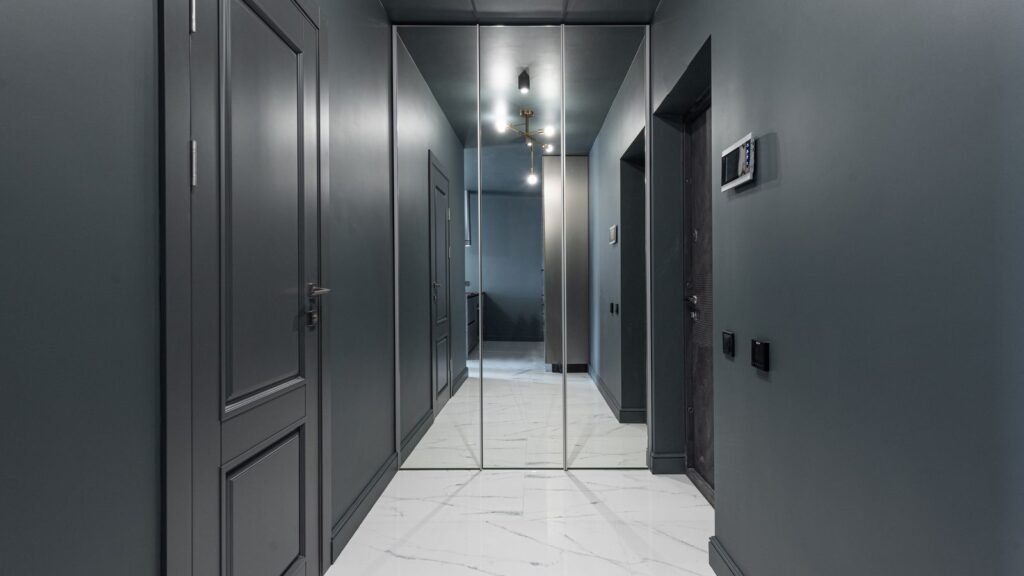
Shared hallways, stairwells and entrance areas need to be kept clear and clean, not treated as informal storage for bikes, bins or abandoned furniture. This matters for two separate reasons. Cleanliness is one, and fire escape routes staying genuinely clear is the other, since a cluttered stairwell is both an inspection failure and a real safety risk. Manchester’s HMO standards documentation is explicit that entrance doors to communal areas should self close and that means of escape must be kept clear at all times, which in practice means the hallway cannot double as a dumping ground between tenancies.
Where landlord responsibility ends and tenant responsibility begins
Licence conditions place the underlying condition, fixtures and fittings, and the provision of a cleanable environment on the landlord. Day to day tidiness inside a tenant’s own room sits with that tenant. The genuinely grey area is the shared kitchen and bathroom in between tenancies, and this is where most HMO landlords either get organised or get caught out.
The properties that pass inspection cleanly almost always have one thing in common: a landlord who has arranged a scheduled clean of the shared areas rather than leaving it to whichever tenant feels most strongly about a dirty hob that week. Six or eight unrelated adults sharing a kitchen rarely self organise a fair cleaning rota that survives more than a month, and the landlord ends up owning the consequences regardless of whose turn it technically was.
Building a schedule that survives an inspection
A workable HMO cleaning schedule for the shared areas has three layers. A weekly visit covering floors, surfaces, bins, hallway and stairwell in every property, which catches the everyday build up before it becomes a problem. A monthly deeper pass on the shared kitchen specifically, including inside the oven, extractor filters, behind appliances where accessible and the fridge freezer if it is a shared unit, since these are the areas an inspector will open a cupboard or pull out an appliance to check. And a documented record of every visit, dated, with photographs where practical, because the same rule applies here as it does to repairs: what you can show matters as much as what you did. A landlord who can produce twelve months of dated cleaning records for a shared kitchen is in a completely different position at inspection than one who says the tenants generally keep on top of it.
Communal repairs and cleaning tend to sit close together in practice, since a landlord managing the schedule for shared areas is usually the same person who needs to know when a shared kitchen extractor has stopped working or a communal window will not close properly. If repairs alongside the cleaning schedule are part of what you are trying to keep on top of, our guide to landlord repair responsibilities in the UK covers the legal side of that in more detail.
What happens if a shared space fails inspection
An inspector who finds a genuinely dirty or hazardous shared space does not simply make a note and move on. It can trigger a formal notice requiring works, and repeated or serious failures put the licence itself at risk, alongside the financial penalties that come with breaching licence conditions. None of that is proportionate to the cost of a proper cleaning schedule, which is exactly why the landlords who invest in one rarely think twice about it after the first renewal goes smoothly.
Selective and additional licensing across Manchester
Manchester has expanded its licensing schemes over recent years specifically because the council found a clear link between poorly managed HMOs and wider issues in certain neighbourhoods, from fly tipping to overcrowding. Selective licensing can apply even to a single let property in a designated ward, not just shared houses, which catches some landlords by surprise if they have only ever thought about licensing in the context of larger HMOs. The practical lesson is not to assume your property is exempt because it is small or because it has always operated without a licence in the past. Boundaries change, and the council periodically reviews and extends designated areas, so a property that did not need a licence two years ago may need one now.
What inspectors actually do on a visit
An HMO inspection is not a quick glance at the front door. An officer will typically walk every shared area, open cupboards in the shared kitchen, check extraction in the bathroom is actually working rather than just present, test that fire doors close properly and that escape routes are genuinely clear, and ask to see safety certificates alongside anything you can show about ongoing management, including cleaning. Landlords who arrive at inspection with a folder of dated cleaning and maintenance records, rather than a verbal assurance that everything is fine, consistently have shorter, less stressful inspections. It signals a managed property rather than one that happens to look acceptable on the day somebody is due to visit.
Getting your shared spaces onto a proper schedule
We run scheduled communal cleaning across licensed HMOs throughout Manchester, from single shared houses to larger portfolios, with a dated visit record for every job so you have the evidence ready if an inspection ever asks for it. If your shared kitchens, bathrooms and hallways are currently running on whatever the tenants manage between themselves, get in touch and we will put a proper schedule around them before your next renewal comes up.


Want this done properly at your property?
Tell us the building and the problem. We quote from a written specification, and contracts start with a three-month trial rather than a long tie-in.