Shared Desk Cleaning Between Shifts in Manchester Offices
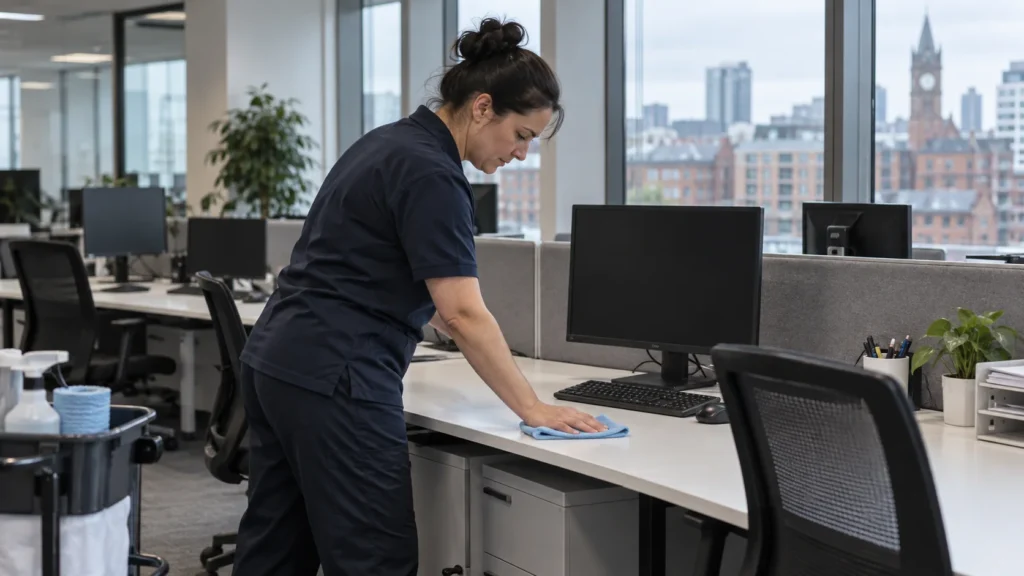
In a shared Manchester office, a desk can change users during the day while the cleaner attends at an agreed separate time. That mismatch creates a practical question for the person running the workplace: who resets the station between users, and what is left for the professional cleaning round? A workable answer separates the quick handover from the planned clean. It gives the incoming colleague a usable desk without asking staff to handle specialist products or expecting the evening cleaner to know which desk changed hands at noon.
This guide is for offices that use hot desks, rota-based seating or shared reception stations. It focuses on surfaces and equipment, clear ownership and a schedule that can be checked. It does not promise that a surface can be made germ-free. An effective plan starts with what is actually used, what can safely be cleaned and when the next person arrives.
Start with the real handover, not the cleaning timetable
Walk through one ordinary desk change before drafting a checklist. Does the first user leave at lunchtime while the next arrives immediately? Is the workstation reserved by an app or chosen on arrival? Is there a shared headset, phone, docking station or chair? Can the desk be cleared without moving confidential papers? These details determine what the handover involves and whether support from the office team is needed.
A clean desk policy helps, but the policy alone does not wipe the desk. Assign the departing user the simple job of clearing personal items and reporting a spill or damaged equipment. Assign the incoming user a quick visual check and a way to report a station that is not ready. Give the contracted cleaner the scheduled surface-cleaning tasks agreed in the specification. If the business wants a staffed daytime reset between bookings, name it explicitly in the contract instead of assuming it is included in an evening office cleaning service in Manchester.
Map the touchpoints at each station
A desk is more than its large flat top. The places users repeatedly touch may include the chair arms and adjustment levers, telephone handset, monitor controls, desk-edge switch, drawer handle, docking cable, keyboard and mouse. Their cleaning needs differ. A laminate desk can often be wiped with a product selected for that finish. A keyboard has openings and electronic components; liquid should not be sprayed into it. A fabric chair may need a different method from a hard plastic armrest.
Make a short equipment register for the actual office rather than copying a generic checklist. Record whether each item belongs to the business or to the user. A personal laptop or headset should normally remain the user’s responsibility unless a different arrangement has been agreed. For shared devices, ask the equipment owner or IT team which cleaning method the manufacturer permits. The cleaner should have that instruction before a new product touches a screen, keyboard or docking station.
This distinction also protects the cleaning schedule. If staff move a station’s equipment, disconnect cables or leave drinks and paper across the surface, the cleaner cannot safely complete a consistent pass. Clear-desk time at the end of each shift is therefore part of the cleaning system, even though it is not itself a professional clean.
Build a simple between-user reset
The between-user reset should be short enough to happen every time. First, the outgoing user removes belongings, cups and loose papers. Any spill, visible soil or damaged fitting is reported through one named channel. Next, the desk is visually checked, and the agreed wipe for the desk’s finish is used according to its label and the workplace’s instructions. Shared equipment is treated only by the method approved for that equipment. The incoming user should be able to see that the station is ready without hunting for a cleaner or wondering who was last there.
Place suitable materials where staff can actually find them. Confirm that staff can obtain the agreed supplies when the planned reset is needed. On the other hand, leaving an unlabelled chemical bottle beside every keyboard is not a sensible substitute for a method. The employer should choose products and instructions for the task, keep labels available and tell staff which surfaces they are meant to handle. The Health and Safety Executive’s cleaning risk-assessment guidance explains the need to identify work risks and put controls in place. That principle applies to the person doing the between-user reset as well as to the contracted cleaning team.
If visible food or drink has entered an electrical device, stop using the device and refer it to the equipment owner or IT contact. A surface wipe is not a repair. Similarly, if a spill reaches the floor, the priority is to keep people clear and arrange safe removal and drying; a desk reset should not leave a new slip hazard in the aisle.
Give the professional cleaner the deeper, repeatable tasks
The planned cleaning round can cover cleared desk surfaces, accessible hard touchpoints, waste points and the surrounding floor. It may include scheduled detail work such as chair bases, desk legs, cable-access areas and edges that are not practical to reach during a brief handover. Agree the frequency for each task in writing. A station used by multiple people every day may need a different plan from an occasionally booked meeting-room desk. The frequency should follow use and the condition observed, not an arbitrary promise that every office needs the same number of visits.
Specify the boundaries as carefully as the tasks. Will cleaners move notebooks and paperwork? Can they handle staff-owned devices? Who unlocks a drawer or reports a broken chair? What happens when a surface has been left cluttered? A practical specification might say that the team cleans accessible surfaces and records obstructed stations for the office manager. That is more honest and more auditable than claiming every square centimetre was cleaned while half the desks were covered with belongings.
The whole office still needs a coordinated plan. Shared desks lead users through entrances, corridors, meeting rooms, kitchens and washrooms. A desk programme should sit inside the broader commercial cleaning plans for Manchester workplaces schedule, with separate checks for spaces whose use peaks at different times. For example, a mid-afternoon meeting-room reset and an evening desk clean solve different operational problems. A tidy desk does not compensate for a neglected break area.
Plan around the busy parts of the day
A Manchester office may include commuters, hybrid staff, visitors and teams whose shifts overlap. Observe a real week of bookings before setting the service window. A Monday morning rush may produce more desk changes than Friday afternoon. A reception workstation may be occupied continuously, while a training room may sit empty for days and then host several groups in one day. This is a reason to schedule by actual use, not to invent a blanket daily treatment for everything.
When cleaners work during occupied hours, agree a route that does not interrupt calls or block accessible paths. Keep cords, caddies and waste bags out of the walking line. If a floor has to be wet-cleaned, the timing and segregation matter more than merely placing a warning sign. The same office manager who coordinates desks should know who responds to an unexpected spill while the evening team is off site. A single named response route prevents a drink spill from sitting beside a desk until the next scheduled visit.
For businesses with early and late teams, a brief daytime attendance may be more useful than adding another full evening visit. That decision depends on how many desks turn over and which shared areas become soiled. Ask the cleaning provider to quote the actual handover need: number of stations, typical changeover times, equipment boundaries and expected access. It is easier to compare proposals when each supplier is pricing the same work.
Keep the records small enough to be useful
A lengthy checklist that nobody completes is not evidence of a clean office. Use a short record showing the date, area, assigned task, completion and any exception. The exception matters: a locked room, occupied workstation, damaged surface or spill needing a different response should be visible to the office contact. The next shift then knows what was missed and why, instead of assuming a tick means every station was accessible.
Separate professional cleaning records from user handovers. The cleaner’s log can confirm a scheduled round; a booking system or simple desk-ready marker can support staff changes. Do not ask cleaners to sign off a midday handover they never saw. At the weekly review, look for repeated exceptions: one bank of desks always cluttered, supplies that regularly run out, or a meeting room that becomes busy after the cleaner leaves. Adjust the process at that point rather than adding more boxes to the form.
Supervisors can check a sample of stations against the agreed specification. Look at the desk surface, touchpoints that are in scope, floor edge and waste area. Ask staff whether the station is consistently ready at handover. If the answer is no, establish whether the failure is a missed cleaning task, the timing of the round, unclear staff responsibilities or equipment that cannot be cleaned by the selected method. Those are different fixes.
Choose products for materials and people
A product that works on a hard desk is not automatically suitable for a screen, a fabric panel or a painted finish. Follow the manufacturer’s instructions for the equipment and the cleaning product, including dilution, contact and drying requirements where relevant. Do not mix products or decant them into unmarked containers. Staff assigned to a quick handover should receive clear, limited instructions rather than a cupboard of chemicals and a vague order to make the desk safe.
Use a cloth system that does not simply carry visible dirt from one station to the next. Replace or launder cloths according to the chosen method, and keep the office’s equipment-cleaning materials separate from washroom materials. The cleaner should know where used items go and who replenishes the set. If a surface or device is unusually delicate, record the exception and agree a separate method. Damaging an expensive screen in pursuit of a uniform checklist is not a successful clean.
It is also worth checking how the desk programme relates to an office deep clean and daily clean. Daily work controls ordinary use; a deeper visit reaches under and behind equipment, chair bases and other accessible detail areas at an agreed interval. Neither replaces a user clearing the station between bookings.
Coordinate desks with kitchens and washrooms
People who share a desk also use the same handles, break areas and washrooms. Those spaces may need checks at times unrelated to the desk turnover. Build a short route around the workplace rather than treating the hot-desk zone as an isolated island. For a small office, one visit may cover all agreed tasks. For a larger or heavily used site, daytime touchpoint checks and a separate evening floor and desk round may be clearer.
Define who reports a washroom issue during the day and who responds. An evening cleaner cannot correct an empty or soiled facility at 11 am unless daytime cover is in the scope. Set inspection frequency from actual use and record the exceptions. Apply the same principle to shared desks: observe the use, assign the response and check whether the arrangement works.
Questions to settle before asking for a quote
Who resets a workstation between users?
Name the responsible staff member or separately agreed daytime cleaner. A scheduled evening round should not be assumed to cover every handover.
Can one product clean desks and shared devices?
Check the finish and equipment instructions. Use only the approved method for each item and leave repairs with the equipment owner.
Does a desk programme guarantee a germ-free station?
No. Define the cleaning tasks and review their delivery without treating the attendance record as proof that every risk is eliminated.
How often should shared stations be cleaned?
Use the actual booking pattern, observed condition and agreed scope. Review whether the routine and between-user reset cover the times the desk is used.
Are kitchens and washrooms included automatically?
List those areas and their tasks separately. Agree the responsible person and any daytime response rather than assume the desk plan covers them.
Count the shared desks and note the busiest handover windows. List the shared devices and identify who owns their care instructions. Decide whether staff will reset a desk between users or whether a daytime cleaner is required. Record the materials of any unusual surfaces. Identify a contact for spills, damage and inaccessible desks. Finally, decide what evidence of completion would help the office manager, rather than requesting a large report nobody will read.
Send that information to the provider and ask for a scope that distinguishes handover work, routine cleaning and periodic detail work. Compare the proposed service window against actual occupancy. Check how exceptions will be reported and how a missed station will be recovered. A useful quote should let you see what happens on a busy Tuesday when every desk changes hands, not just what happens in an empty office after hours.
Exclusive Property Facilities can help Manchester offices turn those practical requirements into an office cleaning schedule with clear boundaries. If your current arrangement leaves shared stations uncertain between shifts, tell us how your desks are used, when the changeovers happen and which areas need daytime attention. We can discuss a cleaning scope around the real pattern of use.

Want this done properly at your property?
Tell us the building and the problem. We quote from a written specification, and contracts start with a three-month trial rather than a long tie-in.