Fire Doors and Escape Routes in a Manchester Managed Block
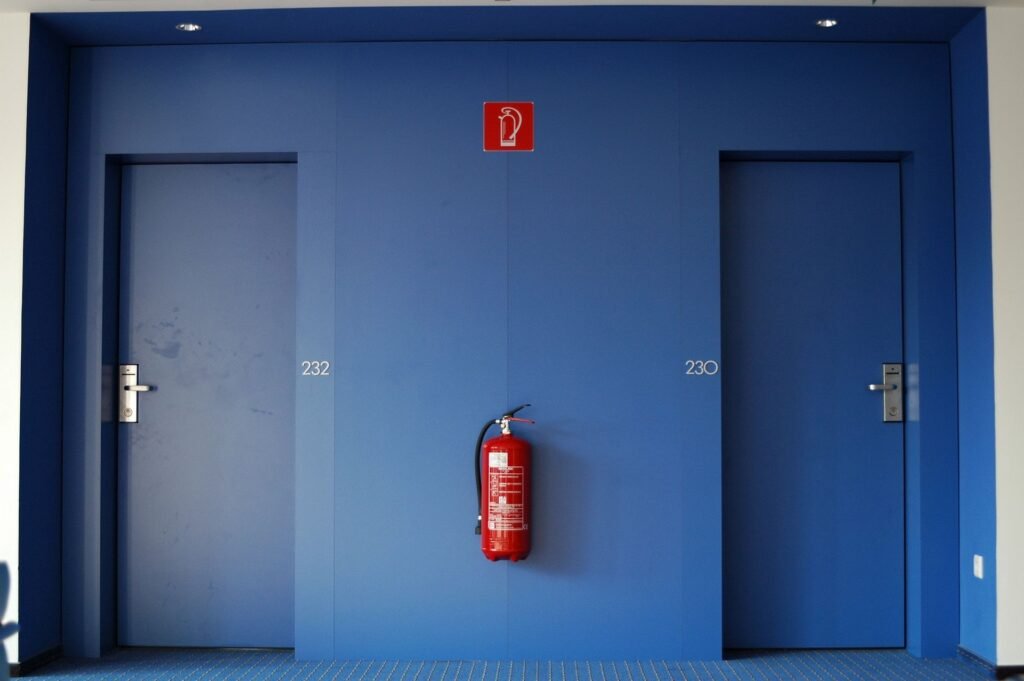
A fire door that looks perfectly normal can still be failing at the one job it exists to do. From across a corridor, a fire door and an ordinary door look almost identical, same paint, same handle, same fire-action sign taped up nearby that nobody reads twice. What actually matters is hidden in the details: whether it closes fully onto the latch every time, whether the seal around its edge is intact, whether someone has wedged it open “just for today” so often that today has become every day. A caretaking round that walks past these doors every week is one of the best places to catch that kind of quiet failure, provided it knows what to actually look for.
Two layers of law, and which applies to your block
It helps to be precise about which rule applies where, because the two get mixed up constantly. Every building with common parts shared by two or more homes sits under the general duty in the Fire Safety Order, which the government’s own guidance summarises as applying to “all workplaces and the common parts of buildings containing 2 or more domestic premises,” placing a duty on “anyone in control of these premises (the Responsible Person, usually the owner or landlord)” to “undertake and record a fire risk assessment and put in place and maintain general fire precautions.” That duty exists regardless of how tall the building is, and it already covers keeping fire doors in working order as part of general fire precautions.
On top of that general duty, a specific and more prescriptive regime applies once a residential building crosses a defined height threshold. The Fire Safety (England) Regulations 2022 fact sheet sets out that for “all multi-occupied residential buildings in England with storeys over 11 metres in height,” the responsible person must “undertake quarterly checks of all fire doors (including self-closing devices) in the common parts,” and, on a best-endeavours basis, “annual checks of all flat entrance doors (including self-closing devices) that lead onto a building’s common parts.” This has been “a legal requirement from 23 January 2023.” A smaller block under that height is not caught by this specific quarterly and annual regime, but its responsible person still carries the general duty to keep fire doors and precautions properly maintained, so “we’re under 11 metres” is a reason the paperwork looks different, never a reason to let the doors themselves slide.
Working out exactly who the responsible person actually is in a leasehold block is not always obvious, and it is worth confirming rather than assuming. It might be the freeholder directly, a resident management company where leaseholders jointly own the freehold, a right to manage company, or a managing agent instructed to act on the freeholder’s or the company’s behalf. Whoever it is, a caretaking or cleaning contract for the block is instructed by that party and reports back to them, and part of a proper handover with any new managing agent is making sure everyone agrees who that responsible person actually is before assuming someone else is already covering it.
What an actual, useful fire door check looks at
A fire door check that is worth doing goes well beyond glancing at a closed door from the far end of a corridor. It means opening the door and checking it swings shut fully and latches from a partly open position, not just from wide open, since a door that only self-closes from one specific angle will fail exactly when someone has left it ajar. It means running a hand along the intumescent strip and cold smoke seal set into the door or frame, checking for damage, for gaps, or for the seal being clogged solid under years of repainting, since paint applied without masking the seal is one of the most common ways a perfectly good fire door quietly stops working. It means checking the door and frame for damage, splits, or gaps around the edges that should not be there, checking any glazed vision panel is intact and correctly fire-rated rather than replaced at some point with ordinary glass, and confirming door furniture, handles, hinges and the self-closing device itself are all actually fitted and functioning, not loose, missing, or unscrewed.
The failure patterns a caretaking round sees again and again
Certain problems turn up on almost every block, usually because they come from residents solving a small daily annoyance in a way that quietly removes a safety feature. A door wedge or a fire extinguisher pushed under a communal fire door to stop it swinging shut on a delivery, a self-closer that has been unscrewed or disconnected because it slams too loudly, layers of repainting over the years that have sealed an intumescent strip solid without anyone meaning to, and a vision panel cracked during a house move and never reported, are the small, everyday things a caretaking visit is well placed to spot precisely because it happens on a schedule, not just when something has already gone wrong. Reporting these plainly, with a note of exactly which door and what was found, gives whoever holds the responsible person duty the evidence they need to get it fixed rather than a vague sense that something in the block “isn’t quite right.”
Why a dated log matters as much as the check itself
A quarterly or annual check that exists only as someone’s memory of having walked the corridor is worth very little if a fire and rescue service inspection, an insurer, or a resident dispute ever asks for evidence. The 2022 regulations are built around a specific, repeatable check being carried out on a specific schedule, which only really works as protection for the responsible person if it is written down: which door, on what date, what was found, and what was done about it. A simple dated log, door by door, turns “we check the fire doors” into something a responsible person can actually produce on request, and it is the difference between a defensible paper trail and a plausible-sounding claim with nothing behind it. Where we carry out these checks as part of a caretaking round, that log is kept as a matter of course, not created retrospectively if it is ever asked for.
Getting residents on side, without turning it into a lecture
Most residents who wedge open a fire door are not being careless. They are carrying shopping, moving a pushchair, or letting a delivery through, and a door slamming shut on them is a genuine daily annoyance. Telling people off rarely changes the behaviour for long. What works better is making the reason visible without being preachy: a short, clear notice near the worst-offending doors explaining what the door actually does in a fire, rather than a generic “fire door, keep shut” sign nobody reads after the first week. Where a wedge or a prop keeps reappearing on the same door, that is also useful information in itself, often a sign that the door’s location or its self-closer tension is making everyday life genuinely harder than it needs to be, which is worth flagging to the responsible person as a design problem to fix, not just a discipline problem to repeat.
Where a caretaking check ends and a specialist inspection begins
Spotting a wedged-open door, a disconnected closer, or a cracked panel is well within a properly trained caretaking round. Certifying that a door still meets its original fire rating, assessing whether a repaired or repainted door remains compliant, or carrying out the kind of structural check a formal quarterly inspection under the 2022 regulations requires, is a job for a competent, trained fire door inspector, and we are clear about that boundary with every client. Our role sits inside the wider building upkeep covered in our property maintenance service, and alongside the general round we describe in what a block caretaker service actually covers: routine, recorded, recurring checks that support the responsible person’s duty, not a replacement for their formal inspection regime.
Escape routes are the other half of this, and they are just as often the problem
A perfect fire door on a corridor blocked by residents’ bikes, mobility scooters, pushchairs or bin bags left out between collections achieves very little, since an escape route has to be genuinely clear, not just theoretically available. Communal stairwells and corridors accumulating stored items is one of the most common and most avoidable fire safety problems in a managed block, and it is exactly the kind of thing a regular communal area cleaning visit naturally keeps on top of, alongside the fire door checks themselves, because both come down to the same habit: walking the same routes on a schedule and not letting small, everyday clutter become a genuine hazard by the time anyone official comes to look.
If you manage a block in Greater Manchester and want a caretaking and cleaning contract that actually keeps an eye on fire doors and escape routes between formal inspections, rather than one that only turns up for the bins, get in touch through our contact page and we can talk through what your building specifically needs.

Want this done properly at your property?
Tell us the building and the problem. We quote from a written specification, and contracts start with a three-month trial rather than a long tie-in.