How Often Should Fire Alarms Be Tested? BS 5839-1 Explained
Someone asks who tested the fire alarm last week and nobody has a straight answer. The logbook has a three week gap in it, the last service certificate is buried in an email thread, and the fire risk assessment review is due. That is usually the moment the frequency question gets asked properly, and it is rarely asked out of curiosity. It gets asked because an insurer wants evidence, a fire officer has visited, a managing agent has requested records, or an incoming tenant has asked what the building’s compliance position actually is.
The answer is not complicated once the two separate rhythms are clear. BS 5839-1, the British Standard code of practice for fire detection and fire alarm systems in non-domestic premises, describes a short in-house user test carried out every week and a professional inspection and service carried out at roughly six month intervals. They do different jobs. Passing one does not cover you for skipping the other, and a building that only ever sees an engineer twice a year is not meeting the standard no matter how good those two visits are.
The two testing rhythms every building needs
Think of it as a fast loop and a slow loop. The fast loop is weekly and it is done by your own people. Its purpose is to confirm the system still responds and that anyone in the building recognises the sound of the alarm and knows what it means. It takes a few minutes and needs no specialist qualification. The slow loop is the periodic inspection, test and service carried out by a competent engineer who opens the panel, checks the batteries, tests detection devices in rotation across visits, verifies transmission to any monitoring centre, and issues a certificate.
Both loops feed the same record. A building with a full weekly log and a current service certificate can answer any question a fire officer asks in about thirty seconds. That is the practical reason we build both into the schedules we run when we handle fire alarm testing in Manchester for offices, blocks and mixed use buildings. The weekly test is the part that slips, because it depends on a named person remembering, and staff turnover quietly erases it.
What the weekly user test actually involves
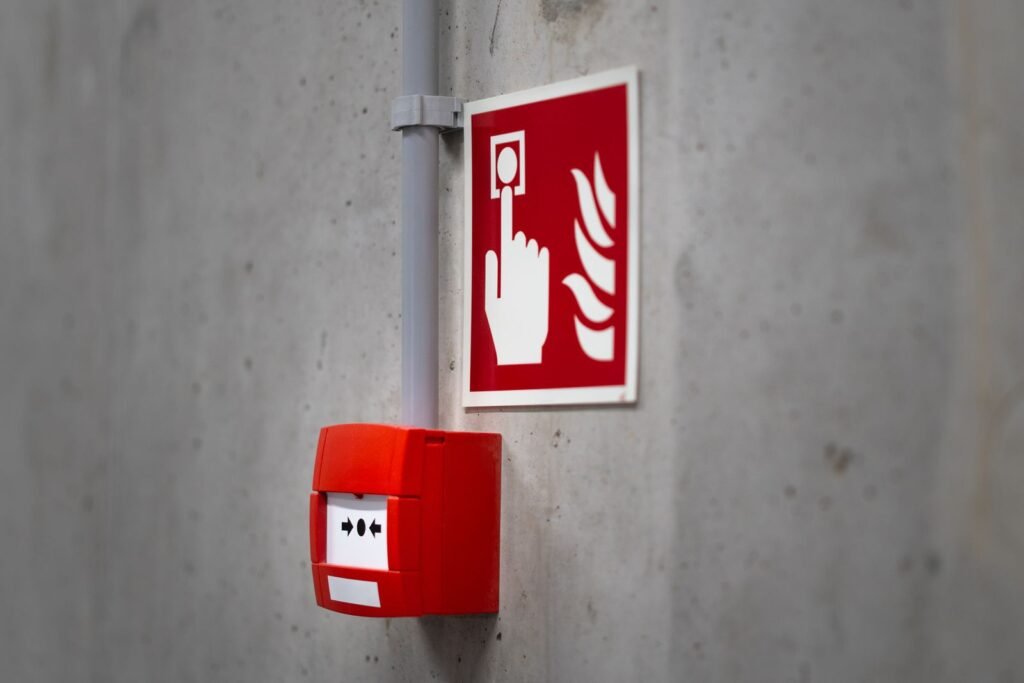
The weekly test is a single manual call point operated with the test key, followed by a check that the sounders across the building actually sound. A different call point is used each week, working through the devices in the building in rotation so that over time every call point has been proven. The point of rotating is simple. Testing the same call point by the reception desk every Monday for two years proves that one device works and tells you nothing about the twelve others.
Timing matters more than people expect. BS 5839-1 recommends carrying out the test at roughly the same time on the same day each week so occupants learn to recognise it as a test rather than evacuating, and so that anyone who does not hear it can report the fact. In a Manchester office block with floors let to different tenants, that consistency is what stops a routine test turning into an unplanned building evacuation and a call to Greater Manchester Fire and Rescue Service.
Two practical points get missed. If the system transmits to an alarm receiving centre or a monitoring company, they need to be told before the test starts and told again when it finishes, otherwise you generate a false call. And the alarm should be silenced and the system reset promptly, with a note made of anything that did not behave as expected, such as a sounder that was noticeably quieter than the rest or a zone that failed to display correctly on the panel.
Monthly checks that sit alongside the weekly test
Where a system has a standby generator rather than battery standby, that generator needs a monthly test under load. Some buildings also run monthly checks on emergency lighting and on door hold-open devices linked to the alarm, because those devices only prove themselves when the system is triggered. These are separate from the weekly call point test and belong in their own logbook entries, not merged into one line.
How often a professional inspection is required
Successive inspection and servicing visits should be undertaken at intervals of approximately six months, which is where the widely quoted twice a year figure comes from. In practice most buildings run a six monthly cycle with the engineer testing a proportion of the detection devices at each visit, so that every detector in the building is tested across a full cycle rather than all of them at once.
Larger or higher risk premises often need more frequent attendance. A building with a high number of unwanted fire signals, a system that has been extended piecemeal over the years, or premises where the fire strategy depends heavily on detection may warrant quarterly attention. That judgement belongs with the person carrying out the fire risk assessment, not with a default entry on a maintenance schedule.
The competence of whoever attends is part of the requirement. The standard expects the work to be carried out by someone with specific knowledge of the type of system installed, access to the relevant documentation and spares, and enough experience to interpret what the panel is telling them. A general handyman ticking a box does not satisfy this, and an insurer will notice.
What changed in BS 5839-1 in 2025
The 2025 revision of the standard, which replaced the 2017 edition, tidied up a long running practical problem around scheduling. Under the older wording, a service carried out at six months and one week was technically outside the recommended period, which caused endless argument when an engineer visit slipped by a fortnight because of access or holidays.
The Fire Industry Association’s technical guidance on servicing intervals confirms that the 2025 revision allows a variance of one month either side, so an inspection carried out anywhere between five and seven months after the previous one is acceptable. The date of acceptance of the system is treated as the datum for those periods, which means the cycle is anchored to when the system was handed over, not to whenever the last engineer happened to turn up.
That flexibility is useful, but it is not permission to drift. Each visit still counts from the previous one, so repeatedly taking the seven month option pushes the schedule later and later until a year has quietly become three services instead of four. The sensible approach is to book against the six month datum and treat the variance as headroom for access problems.
What belongs in the fire logbook
The logbook is the evidence. If a test is not recorded, then as far as an inspecting officer is concerned it did not happen. Every weekly test entry should carry the date, the time, the identity of the call point tested, usually by zone and device number, confirmation that the sounders operated, the name of the person who carried out the test, and a note of any fault found and what was done about it.
The logbook should also hold the service certificates and engineer reports, records of any false or unwanted alarms with the suspected cause, details of any faults and how long the system was impaired, records of alterations to the system such as added detectors after a partition change, and evidence of staff training on how to operate the system. Where a building has changed use or been subdivided, the zone plan needs updating alongside it.
Paper logbooks kept in a cupboard next to the panel still work perfectly well. What matters is that the book lives where the panel lives, that a named person owns it, and that the entries are made at the time rather than reconstructed from memory the week before an inspection. On sites where our teams provide on-site caretaking cover, the logbook sits in the same routine as the other daily building checks, which is the simplest way to stop it going stale.
Who carries the legal duty
In England and Wales, fire safety in non-domestic premises and in the common parts of residential buildings falls under the Regulatory Reform (Fire Safety) Order 2005. It places duties on the responsible person, which in most cases is the employer, the building owner, the landlord or whoever has control of the premises. Where several parties have control, such as a landlord and multiple commercial tenants in one building, the duty is shared and each party has to cooperate with the others.
The order requires that fire safety equipment is subject to a suitable system of maintenance and kept in efficient working order and in good repair. It does not name BS 5839-1 or state a weekly interval. The standard is the recognised way of demonstrating that the general legal duty has been met, which is why enforcing authorities and insurers work to it. Deviating from the standard is possible if the fire risk assessment justifies it, but the justification has to be written down and defensible.
Enforcement is real. Prohibition and enforcement notices are served on buildings in Manchester every year, and a missing or fabricated logbook is one of the fastest ways to lose credibility during an inspection, because it casts doubt on every other record in the building.
How often landlords and residential blocks need to test
Communal areas in blocks of flats
Common parts of a block are non-domestic for fire safety purposes, so the communal system falls under the same weekly and six monthly rhythms described above. In a block operating a stay put strategy there may be no communal sounders at all, and the testing then focuses on the detection and any smoke control or door release equipment. Higher risk residential buildings carry additional duties around record keeping and information sharing with the fire service, which sit on top of the standard testing schedule rather than replacing it.
HMOs and converted mill buildings
Manchester has a large stock of converted mills, subdivided townhouses and licensed HMOs, and these are where testing frequency most often goes wrong. Systems in these buildings are frequently mixed, with a communal system covering escape routes and separate detection inside individual flats. Access to test devices inside occupied units is the recurring obstacle, and it is worth agreeing an access protocol with tenants in writing rather than discovering the problem on the day the engineer arrives.
Where testing schedules usually slip
The failures we see are consistent. The weekly test stops when the person who owned it leaves and nobody inherits the key. The same call point gets tested every week because the rotation was never written down. Tests get carried out but never recorded, which is legally equivalent to not testing. Faults get noted in the book and then never chased, so the same defect appears in twenty consecutive entries. The service interval drifts by a few weeks at a time until only three services happen in two years.
Each of these is a scheduling and ownership problem rather than a technical one. Name the person, fix the day, write the rotation down, keep the book by the panel, and diarise the service against the acceptance date. Buildings that fold the weekly test into a wider building support package tend to hold the routine better than those relying on one individual to remember, simply because the task survives staff changes.
Putting a schedule in place that holds
If your building currently has no weekly routine, start it this week rather than waiting for the next service visit. Establish which call point is number one, work through them in order, and log every test on the day. If your last service certificate is more than seven months old, treat that as the priority and get the system back onto a clean six monthly datum.
Where there is nobody on site with the time or the confidence to run it, we take the weekly routine off your hands and keep the records straight. Our fire alarm testing service in Manchester covers the weekly user test, the logbook entries and the reporting that goes with them, so the evidence is ready before anyone asks for it. Tell us the building, the system type and how many call points you have, and we will confirm what the schedule should look like.


Want this done properly at your property?
Tell us the building and the problem. We quote from a written specification, and contracts start with a three-month trial rather than a long tie-in.