How to Prepare for Carpet Fitting Day, Room by Room
The real reason fitting day overruns
Most carpet fitting jobs that run late do so for reasons that have nothing to do with the carpet. The fitters arrive on time, the rolls come off the van, and then forty minutes disappear because a wardrobe is still full, the old carpet is still gripped down in the back bedroom, or nobody has worked out where the sofa is going while the floor is bare. On a schedule built around two or three properties in a day, that lost time compounds, and a job booked as a single visit can slip into a second one.
The fix is unglamorous and almost entirely within your control. A few hours of preparation spread across the week before fitting day removes nearly every common delay, and it protects your own belongings in the process. This checklist works through the property room by room, covers what to do with the old carpet and underlay, and sets out clearly where the line sits between your responsibilities and the fitter’s. If you are still settling on a date or want to see how the job runs from measure to final trim, our carpet fitting service in Manchester explains the whole process end to end.
Start two weeks out, not the night before
Preparation fails when it is compressed into one frantic evening. Spread it out and nothing gets forgotten. A workable timeline looks like this.
- Two weeks before. Confirm the fitting date and the rooms included. Decide whether the fitter is lifting and taking away the old carpet or whether you are handling it. Book any bulky waste collection you need, because slots fill up.
- One week before. Empty wardrobes, chests of drawers and bookcases. Heavy furniture is far easier to shift when the contents are already boxed. Start moving boxes into a garage, a spare room or the loft.
- Three days before. Take down curtains and blinds if the fitters need clear access to bay windows. Check that internal doors still open freely and note any that will need trimming.
- The day before. Vacuum the existing carpet thoroughly, move the last of the small furniture, and clear a route from the front door to every room being fitted.
- Fitting morning. Secure pets in a closed room or off site, keep children clear of the work areas, and make sure someone with authority to make decisions is contactable.
Clearing furniture room by room
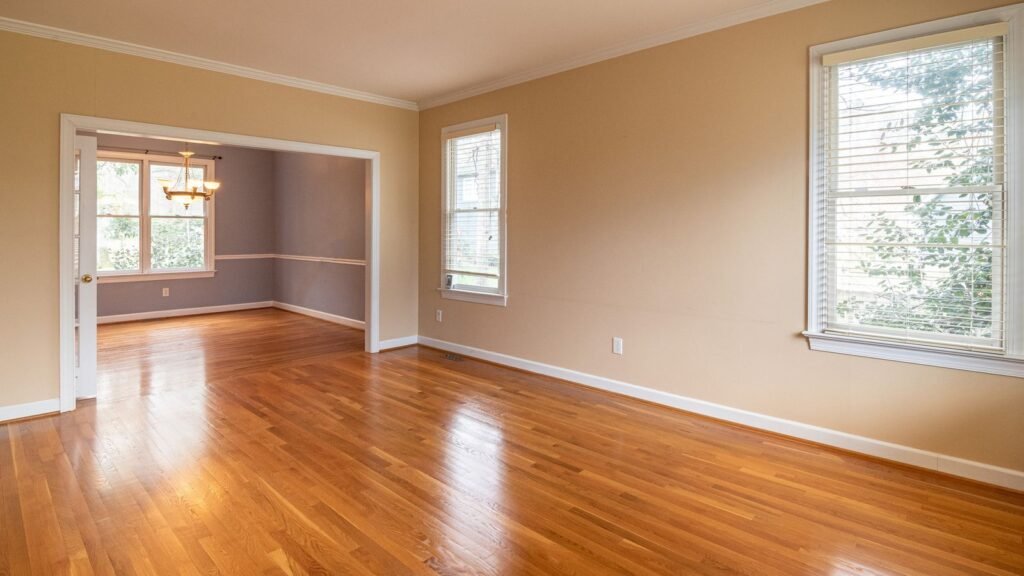
The general rule is simple. Every room being fitted should be completely empty of furniture, floor-standing lamps, rugs and anything stored under beds before the fitters walk in. Where that is genuinely impossible, tell us in advance so we can plan the sequence rather than discover it on the day.
Living rooms and dining rooms
Sofas, armchairs, coffee tables and dining sets all need to come out. Take the feet off heavy sofas if they unscrew, as this makes them far easier to walk through a doorway. Disconnect and box the television, the sound system and the games console, photographing the cable runs on your phone first so reconnection is quick. Freestanding bookcases should be emptied rather than dragged full, because a loaded case can gouge floorboards and strain a back.
Bedrooms
Strip beds, dismantle the frames where you can, and empty everything stored in divan drawers or under the bed. Wardrobes are the single most common hold-up. A full double wardrobe is heavy enough to need two people and often will not clear a landing corner while loaded. Empty it, and if it is a flat-pack unit that has already been moved once, expect it to need care rather than force.
Stairs and landings
Stairs need the same treatment as rooms. Clear the treads completely, remove stair rods and any runner fixings, and take pictures and mirrors off the stairwell wall. Fitters work on stairs from an awkward position and a swinging frame at head height is a genuine hazard.
Home offices and boxrooms
Back up anything important before a desktop machine is unplugged and moved. Filing cabinets should be emptied drawer by drawer. Boxrooms tend to be used as overflow storage, so give yourself extra time here and be realistic about where the contents will live for a day.
If only part of the property is being refitted and the remaining rooms are having their existing carpets cleaned instead, the preparation overlaps closely and it is worth reading our guide on how to prepare your property for carpet cleaning so both jobs can be handled in one coordinated visit.
Lifting and getting rid of the old carpet
Decide early who is doing this, because it changes both the price and the timing. Many households ask us to handle uplift and disposal as part of the fitting, which keeps the mess in one pair of hands. If you would rather do it yourself, there are a few things worth knowing.
Old carpet is heavier and dirtier than people expect. Cut it into strips of around a metre wide with a sharp utility knife, roll each strip tightly and tape it so it does not spring open in the hallway or the car. Do the same with the underlay separately, since mixing the two makes unwieldy bundles. Wear gloves and a dust mask. Carpet that has been down for fifteen years holds a remarkable quantity of fine grit, and lifting it releases all of it at once.
Underneath you will find gripper rods around the perimeter, held by nails or masonry pins, and often hundreds of underlay staples. If new carpet is going down, sound gripper can sometimes stay, but rusted or split rod should be replaced. Staples need pulling rather than hammering flat, because a proud staple will telegraph through a new carpet within weeks. Sweep and then vacuum the bare subfloor properly, as debris left in place will be felt underfoot for years.
For disposal, most local authorities across Greater Manchester run a chargeable bulky waste collection, and household waste recycling centres will generally accept carpet and underlay. Rules on quantities, van access and permits vary between councils, so check your own authority’s requirements before you load the car. Never leave rolled carpet on a pavement or in a communal bin store, which in flats and larger blocks can land you with a fly-tipping charge.
Doors, thresholds and skirting boards
New carpet and underlay together are frequently thicker than what came out, and internal doors that cleared the old floor by a few millimetres will bind on the new one. Check each door in every room being fitted. Open it fully, look at the gap underneath and be honest about it. If it is already tight, it will not clear a new fitting.
Doors can usually be eased by planing or sawing the bottom edge, but this is joinery rather than flooring work and it needs the door off its hinges, a clean cut and the raw edge sealed. Agree in advance who is doing it. If you plan to handle it yourself, do it after the carpet is down so you can measure the real clearance instead of guessing.
Thresholds matter too. Where new carpet meets tile, laminate or vinyl in a doorway, a threshold bar is needed to protect the cut edge and to stop the join lifting. Decide on the finish you want, since the bar is visible and colour matched options exist. Skirting boards should be left in place in almost all cases. A competent fitter trims the carpet neatly to the skirting line, and removing boards to gain a few millimetres tends to create more decorating work than it saves.
Underlay decisions worth making early
Underlay is not an afterthought and it is the one component people regret cutting corners on. It absorbs foot traffic, keeps the carpet feeling comfortable underfoot, adds a useful amount of insulation and sound deadening, and does a great deal to extend the life of the carpet above it.
Old underlay should be replaced rather than reused. It compresses permanently over time, so laying a new carpet over tired underlay wastes much of the benefit and voids many manufacturer warranties. Bedrooms and lounges usually take a thicker, softer underlay because comfort matters more than resilience. Stairs, hallways and landings need something firmer and denser, since a thick soft underlay on a stair nosing wears through quickly and can feel unstable underfoot.
On a solid concrete floor, ask whether a damp-proof membrane is needed beneath the underlay. On a suspended timber floor it usually is not. Settle these questions at the quotation stage rather than on fitting morning, because the wrong underlay on the van means a delay or a compromise, and neither is a good outcome.
Subfloor and moisture checks in older properties
A great deal of Manchester housing stock is Victorian and Edwardian terrace with suspended timber floors, and plenty of later stock sits on a concrete slab. Both need a quick check before fitting day.
With timber floors, walk the room once the old carpet is up and listen for creaks and movement. Loose boards should be screwed down rather than nailed, because screws hold and nails work loose again. Where boards are uneven, cupped or have wide gaps, a hardboard or plywood overlay gives a flat, consistent base and prevents the board lines showing through the new carpet. Do not block or cover airbricks and underfloor vents, since the airflow beneath the floor is what keeps the joists dry.
With concrete, look for damp patches, salt bloom or a musty smell, particularly in ground floor rooms of older properties and in extensions. A freshly laid screed needs a substantial drying period before any floor covering goes over it, and the time required depends on the thickness and the mix, so take the flooring supplier’s guidance on the specific product rather than a rule of thumb. Laying carpet over a subfloor that is still releasing moisture leads to odour, mould and a ruined carpet. If you suspect damp, say so before the fitting is booked. Identifying it early costs a phone call, whereas finding it after the carpet is down costs the carpet.
What your fitter handles and what stays with you
Knowing the split avoids awkward conversations on the day. Your fitter is responsible for accurate measurement and planning the roll, positioning seams sensibly away from doorways and high traffic paths, fitting gripper and underlay correctly, stretching the carpet properly rather than simply laying it flat, trimming to skirtings, and finishing thresholds and stair nosings cleanly. A good fitter also leaves the room swept and takes the offcuts away.
You are responsible for clearing rooms, providing access and power, making the decisions on doors and disposal, and flagging anything unusual about the property in advance. That includes restricted parking, a difficult stairwell, underfloor heating, pets in the house and any known damp.
Standards in the flooring trade are set out by industry bodies, and the Contract Flooring Association is the recognised trade organisation for UK flooring contractors, with a vetting process for members and a code of conduct they are expected to work to. It is a reasonable benchmark to have in mind when you compare quotations. A fitter who talks openly about subfloor preparation, underlay specification and seam placement is working to that kind of standard. One who quotes purely on square metres without asking a single question about the floor underneath is not.
Access, parking and the practical details
Carpet arrives in long, heavy rolls that do not bend. Before fitting day, walk the route from where a van can realistically park to the furthest room being fitted, and think about tight hallway corners, narrow stair turns and low ceilings. Tell us in advance if the property is a first floor flat with a communal stairwell or if the only access is through a rear alley, as both are workable but they change how the day is planned.
Parking is the detail most often overlooked. Across central Manchester, Salford and the inner suburbs, permit zones and restricted bays are common, so arrange a visitor permit or identify a legal loading spot ahead of time. Ten minutes spent on this saves an hour of circling.
Landlords and letting agents have one more consideration. If the fitting is happening between tenancies, sequence it correctly. New carpet should go down after any decorating and after the rest of the property has been cleaned, not before, otherwise it takes the brunt of the work that follows. Where only some rooms are being replaced and the rest simply need restoring to a lettable standard, our end of tenancy carpet cleaning in Manchester can be scheduled alongside the fitting so the property is ready for viewings in one go.
Getting your fitting booked and done properly
Preparation is the part of the job that costs nothing and saves the most. Rooms cleared, old carpet dealt with, doors assessed, underlay agreed and the subfloor checked. Get those five things right and fitting day becomes what it should be, which is a team arriving, working through the property without interruption and leaving you with floors that look and feel the way you imagined.
If you would like the whole thing handled, including uplift, disposal, underlay supply and the fitting itself, we cover Manchester and the surrounding areas with fixed quotations and no surprises on the day. Tell us the rooms, the approximate sizes and anything unusual about the property, and we will confirm what needs doing before we arrive. You can see the full scope of our carpet fitting work and request a measure at a time that suits you.



Want this done properly at your property?
Tell us the building and the problem. We quote from a written specification, and contracts start with a three-month trial rather than a long tie-in.