How Loft Insulation Improves an EPC Rating for Landlords
The number on your certificate is now a letting decision
Most landlords we speak to in Manchester have an EPC filed somewhere and have not looked at it since the property was bought or last re-let. That was a reasonable position for years. It is not one any more. A D rating that felt comfortable in 2019 is now a countdown, because the minimum standard for privately rented homes in England is on a confirmed path upwards, and the cheapest measure available to move a score is the one most landlords leave until last.
Loft insulation comes up in nearly every conversation we have on this, because the answer to the obvious question is yes. Adding or topping up insulation at loft level does improve an EPC rating, usually by a meaningful number of points, and it does so for far less money than almost any other measure an assessor will recommend. What follows is where the rules genuinely stand, how the loft feeds into the calculated score, and the one thing that goes wrong when insulation is installed without thinking about the rest of the building. If you already know the work needs doing, our insulation services in Manchester page sets out what we install and how we work.
Where the legal minimum sits today
Since 1 April 2020 it has been unlawful to let, or to continue letting, a domestic property covered by the Minimum Energy Efficiency Standard regulations where the EPC rating is below E, unless a valid exemption is registered. That bites on existing tenancies, not only new lettings. Under the current standard the landlord funding cap is £3,500 including VAT per property. Where a home still falls short of E after that cap has been spent, or where no qualifying measure can be installed for that money, an exemption can be registered on the PRS Exemptions Register and lasts five years.
Two things get misunderstood here. The first is that an exemption is automatic. It is not. It has to be registered with supporting evidence, and an unregistered exemption is no defence at all if a local authority asks the question. The second is that F and G properties are a rare problem confined to remote old housing. In Manchester’s Victorian and Edwardian terraced stock, particularly the solid wall properties running through Cheetham Hill, Crumpsall, Harpurhey and parts of Salford, an uninsulated roof space combined with an ageing heating system is more than enough to put a house on the wrong side of the line.
What changes by October 2030
In January 2026 the government confirmed, as part of the Warm Homes Plan, that the minimum standard for privately rented homes in England will rise to EPC C by 1 October 2030. The landlord funding cap rises alongside it to a confirmed £10,000 per property across a ten year period, with an exemption route on the PRS register for landlords who cannot reach C within that spend.
The assessment method is changing as well. Domestic EPCs are moving away from the current SAP and RdSAP approach to the Home Energy Model, which becomes the compulsory methodology for new certificates from 1 October 2029 after a transition period in which the two run alongside each other. The reformed certificate reports across several headline metrics rather than a single cost based score, covering fabric performance, heating system, smart readiness and energy cost. Compliance in 2030 is set to be assessed on a dual metric basis, with fabric performance as the primary standard a landlord has to satisfy first.
That last detail is the one worth sitting with. Fabric performance describes how well the building itself holds heat, and insulation is fabric. A landlord who spends the next few years on controls, lighting and smart gadgetry while leaving fifty millimetres of compacted 1980s mineral wool in the loft is optimising for the part of the assessment that is being demoted rather than the part being promoted. We would not advise anyone to plan a portfolio around dates that have not been legislated, and there are interim milestones being discussed that we are not going to quote as settled. The direction of travel on fabric, though, is not ambiguous.
Does loft insulation actually improve an EPC rating
It does, and the mechanism is simple enough that every landlord should understand it. An energy assessor does not measure your heat loss. They record what they can see and evidence on the day, and the software calculates a score from those inputs. Roof insulation is one of those recorded inputs, entered by measured depth and material type. Move that input from little or nothing up to a full modern depth and the modelled heat loss through the roof drops, the modelled running cost drops with it, and the rating rises.
How far it rises depends entirely on the starting point. A property with a genuinely bare loft has the most to gain, and where the starting position is poor it is not unusual for this single measure to shift a rating by a full band. A loft that already carries a reasonable layer will gain less from a top up, though the running cost case often still stands on its own. What never happens is the score improving quietly in the background. If the assessor cannot see or evidence the insulation, the software falls back on a default assumption based on the age and construction type of the property, and that default is almost always worse than the reality.
The evidence problem
This is where landlords quietly lose points they have already paid for. Insulation installed years ago and then buried under loft boarding, stored boxes and a water tank can be effectively invisible on assessment day. An assessor working to the standard conventions has to record what can be inspected or fall back on defaults, and there is no route for them to take your word for it. Keep the installer’s paperwork, keep dated photographs showing the depth before anything is boarded over, and leave a clear inspection point near the hatch. None of that costs anything and all of it protects the score you paid for.
Why it is the cheapest point on the certificate
Insulation measures win on cost per point, which is the only ratio that matters when you are working to a spending cap. Loft work is materials and labour into an accessible void, with no structural alteration, no wet trades and no disruption to the rooms below. Set that against external wall insulation, a full heating system replacement or a solar array, all of which move the score further but cost several times more per property and can bring planning, consent or licensing complications on conservation area streets and on Manchester’s licensed HMO stock.
The National Insulation Association’s guidance on insulation types and where each one applies is a sensible neutral starting point for landlords who want to sanity check advice they have been given, and it makes the scale of the national gap plain, since only a small minority of households currently sit at EPC Band C. It also offers a straightforward test for whether a roof space is worth revisiting at all, treating an unheated loft carrying less than 200mm at joist level as a candidate for topping up.
Draught proofing, the measure that gets skipped
Draught proofing sits in the same cheap and effective bracket as loft insulation and is regularly ignored. Uncontrolled air leakage around loft hatches, suspended timber floors, old sash windows, letterboxes and unused chimney openings is a genuine heat loss route and it is accounted for in the assessment. A loft hatch that has been insulated on its back face but has no compression seal around the frame is, in practical terms, a hole in the ceiling of a heated room. Sealing service penetrations, downlighter gaps and the junction where the ceiling meets the wall plate is low cost work that supports the insulation above it rather than competing with it for budget.
The ventilation and condensation caveat
Here is the part that gets glossed over in most landlord guidance, and it matters more than the points do. Insulating a loft makes the loft space colder. That is the entire purpose, because the heat is being held in the rooms below instead of leaking upwards. A colder roof void holds less moisture before that moisture condenses, so any warm damp air escaping from the house into the loft now finds cold surfaces to settle on. Carry out the work without addressing ventilation and the result is damp timbers, mould on the underside of the roof covering, and insulation that gets wet and stops doing its job.
The controls are straightforward and they are not optional extras. Cross ventilation at the eaves has to be maintained, which means insulation is never pushed tight into the eaves in a way that blocks the airflow path. Bathroom and kitchen extract fans must terminate outside the building rather than discharging into the roof void, and that is a fault we find with some regularity in older conversions and loft alterations across the city. The hatch needs to seal properly. Recessed lighting, soil vent pipes and any other service penetration through the ceiling is a moisture route and should be closed off before the insulation goes down.
The same logic applies to the property as a whole. Tightening a building without dealing with moisture generation and extraction tends to move condensation problems around rather than solve them, and under the Homes (Fitness for Human Habitation) Act damp and mould is a landlord liability rather than a tenant inconvenience. Where a property already shows damp staining, failed pointing, blocked gutters or a slipped slate, that gets fixed before anything goes into the loft, because wet insulation is worthless insulation. Our property maintenance services in Manchester cover the repair and gutter side of that sequence, and it is far cheaper to sort a roof defect before insulating than to strip out a ruined layer eighteen months later.
Sequencing the work around your tenancies
The practical question for a landlord is usually when rather than whether. Loft work does not need the property to be empty and most jobs are completed inside a day, but a void period is still the least disruptive window you will get. Between tenancies you already have unrestricted access, the property is being cleaned and inspected anyway, and a fresh EPC assessment can be arranged without working around a tenant’s schedule. That matters, because the certificate only reflects the improvement once a new assessment has been carried out and lodged.
If you are planning that changeover window, it is worth being clear in advance about where responsibility sits for the condition of the property when a tenancy ends, which is the ground we cover in our guide to end of tenancy cleaning for landlords and tenants. Landlords who bundle the insulation, the repairs and the clean into a single planned void tend to spend less overall and re-let faster than those who treat each one as a separate emergency.
What to check before you commission anything
A short survey of your own before you take quotes will tell you most of what you need to know and will stop you paying for the wrong measure.
- Pull the current EPC for the property and read the recommendations page, not just the headline letter. It tells you what the assessor already flagged.
- Open the hatch and look. Measure the existing depth at several points rather than one, since old material settles and compacts unevenly.
- Check whether the loft is boarded, part boarded or used for storage, because that changes the specification and the cost.
- Look for daylight at the eaves and confirm the ventilation path is clear along the full length.
- Trace where the bathroom and kitchen extract ducts actually go. If either one ends in the loft, that is the first job.
- Look for water staining on the timbers, on the felt and around the chimney breast before anything is covered up.
- Gather any paperwork from previous insulation work so the next assessor can evidence what is there.
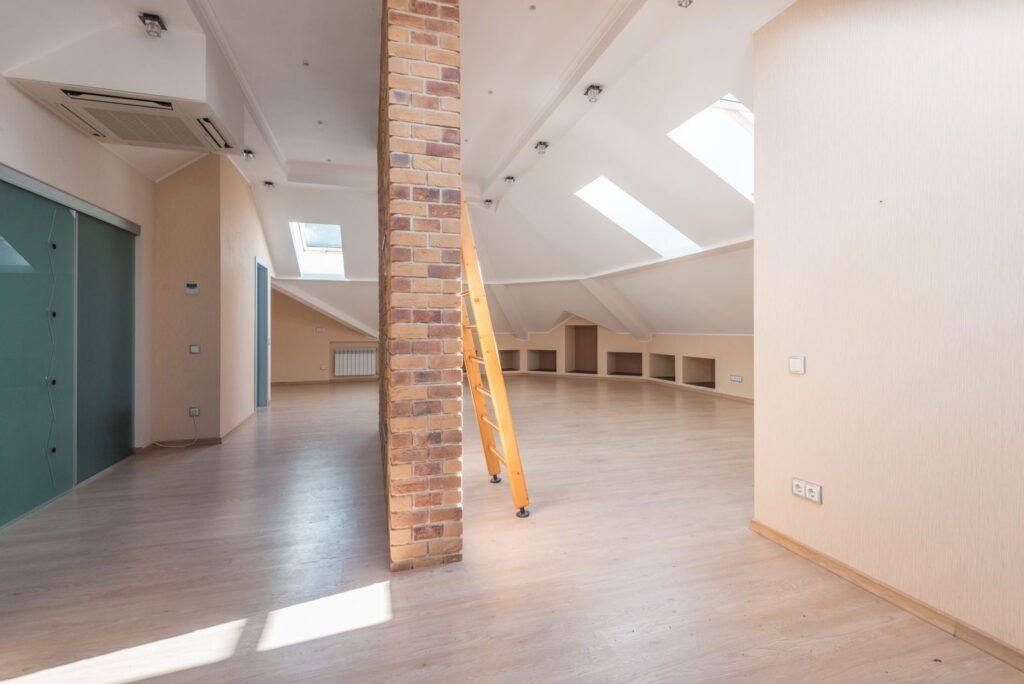
If the loft is a room, a converted space or has a boarded floor carrying real storage load, the answer is different and the specification changes. Insulation at rafter level, or a raised boarded system above the joists, is a different job with different costs, and quoting for it blind from a photograph is how landlords end up with crushed material performing at a fraction of its rated value.
Where to start on a Manchester rental
The sensible order is unglamorous. Fix anything that lets water in, sort out extraction and ventilation, then insulate, then seal the draughts, and only then commission the new assessment so the improvement is recorded properly. Landlords who follow that order tend to reach the score they need for a fraction of the £10,000 cap and keep the remainder in reserve for the heating system work that a Band C target may still demand on the harder properties.
We survey lofts across Manchester for landlords and letting agents, tell you plainly what the existing layer is worth, and quote for the work with the ventilation detail included rather than treated as an afterthought. If you want a straight assessment of where a property stands and what it would take to move it, get in touch and we will arrange a look at the loft.



Want this done properly at your property?
Tell us the building and the problem. We quote from a written specification, and contracts start with a three-month trial rather than a long tie-in.